
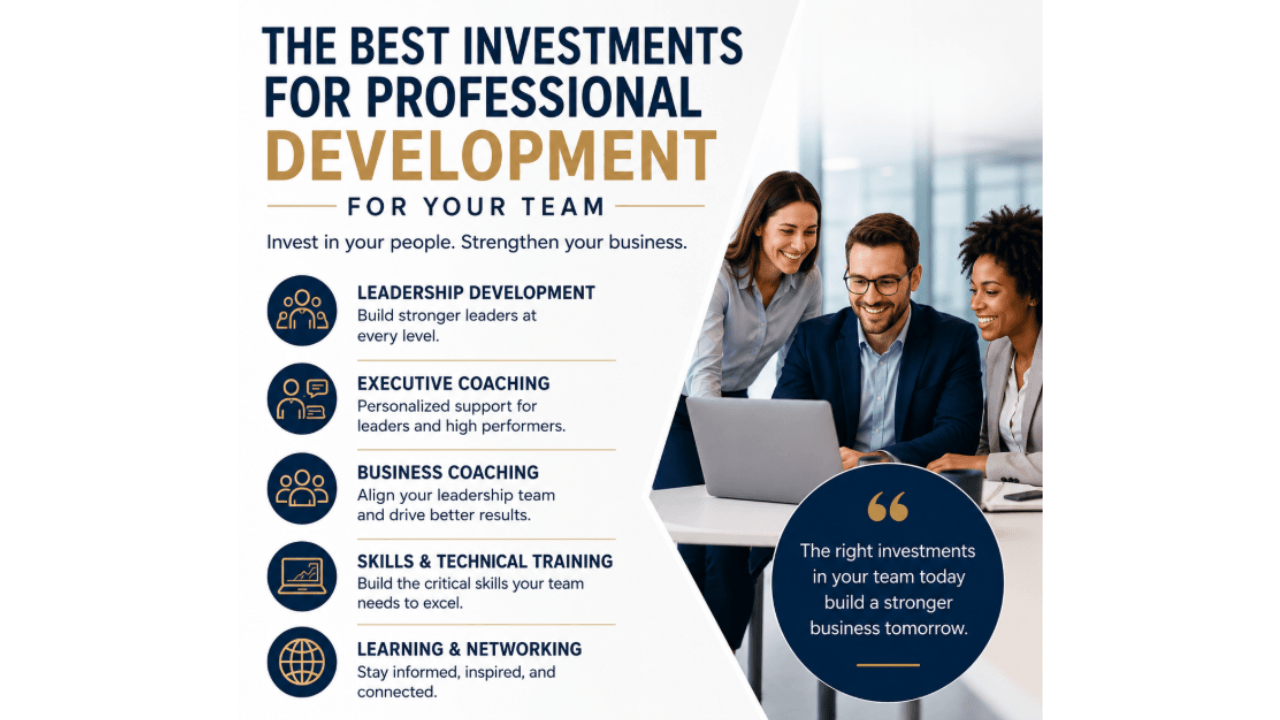
Many business owners and executives recognize the importance of developing their people, but they often struggle with where to invest their training budget. With countless options ranging from conferences and online courses to executive coaching and leadership development programs, it can be difficult to determine which investments will deliver meaningful results.
The best professional development investments are those that align with your organization’s goals, address specific skill gaps, and help employees perform better in their current and future roles. There is no single solution that works for every team. The most effective approach is usually a combination of technical training, leadership development, coaching, and practical learning experiences.
The Best Professional Development Investments
Leadership Development Programs
One of the most valuable investments organizations can make is leadership development. Strong leadership influences employee engagement, retention, productivity, and organizational culture.
Leadership development programs help managers and emerging leaders strengthen skills such as:
- Communication
- Decision-making
- Accountability
- Strategic thinking
- Conflict resolution
- Team development
Many organizations promote high performers into management positions without providing the training needed to lead effectively. Investing in leadership development helps close that gap.
Executive Coaching
Executive coaching is often one of the most personalized forms of professional development available. Unlike traditional training programs, executive coaching focuses on an individual’s specific goals, challenges, and opportunities. Coaching can help leaders improve performance, navigate complex decisions, strengthen communication skills, and develop greater self-awareness.
Executive coaching is particularly valuable for:
- Business owners
- Senior executives
- New leaders
- High-potential employees preparing for larger roles
It is important to understand that coaching is not consulting. A coach does not simply provide answers. Instead, the coaching process helps individuals clarify goals, evaluate options, and improve their ability to lead effectively.
Business Coaching for Leadership Teams
While executive coaching focuses on individuals, business coaching can help entire leadership teams improve alignment, accountability, and execution.
Many growing companies struggle because leaders operate in silos or have differing priorities. Business growth coaching can help leadership teams establish common goals, improve communication, and create systems that support long-term growth.
This type of development often has an impact beyond individual performance because it influences how the organization operates as a whole.
Industry-Specific Training
Technical expertise remains important in most industries.
Investing in certifications, technical training, regulatory education, or industry-specific skills can help employees remain effective as technologies and market demands evolve.
For many organizations, technical training provides immediate operational benefits while leadership coaching and management coaching provide longer-term organizational benefits.
Conferences and Professional Associations
Conferences, trade associations, and industry events can expose employees to new ideas, trends, and best practices.
These opportunities can also expand professional networks and provide valuable peer learning.
However, organizations should be realistic about expected outcomes. While conferences can be inspiring, inspiration alone rarely changes performance. The greatest value often comes when attendees return with specific action plans and opportunities to share what they learned with the rest of the team.
Online Learning Platforms
Online learning has become more accessible and flexible than ever.
Employees can develop skills in areas such as:
- Project management
- Communication
- Technology
- Sales
- Marketing
- Finance
- Leadership
Online learning works best when tied to specific development goals rather than simply providing unlimited access to courses.
What Most Organizations Get Wrong
One common misconception is that professional development is primarily about training. In reality, learning rarely translates into improved performance without reinforcement and accountability. Organizations often spend significant amounts on workshops, seminars, and courses, but fail to create systems that support implementation.
Employees may leave training motivated and informed, but without follow-up coaching, leadership support, and opportunities to apply what they learned, many new skills fade quickly.
The most successful organizations view professional development as an ongoing process rather than a one-time event.
When Coaching Is a Smart Investment
Business coaching and executive coaching can be highly effective when the goal is behavior change, leadership growth, strategic thinking, or organizational improvement.
Coaching is often most valuable when:
- A leader is taking on greater responsibility
- A company is experiencing growth challenges
- A leadership team needs better alignment
- Accountability issues are limiting performance
- Succession planning is becoming a priority
- Business owners want objective outside perspective
Business & Executive Coaching is not always the best solution, though. If an employee needs technical knowledge or compliance training, a course or certification program may be more appropriate. Coaching works best when the challenge involves leadership, decision-making, communication, execution, or business performance.
How Focal Point Approaches Professional Development
At Focal Point Business Coaching Ohio, professional development is viewed as more than simply delivering training content.
The focus is on helping individuals and organizations apply what they learn in ways that improve business results, leadership effectiveness, and long-term growth.
Focal Point coaches use structured coaching systems, proven business frameworks, and practical accountability processes to support development because coaches collaborate and share knowledge across the organization, and clients benefit from both individual expertise and collective experience.
Just as importantly, coaching is not treated as the right solution for every situation. If another form of development is a better fit, the goal is to help individuals and organizations identify the resources that will best support their needs.
The Bottom Line
The best professional development investments are those that help people perform better today while preparing them for future responsibilities.
Leadership development, executive coaching, business coaching, technical training, and industry education can all provide value when matched to the right objectives.
Organizations that see the greatest return typically focus less on training events and more on creating a culture of continuous learning, accountability, and growth. Professional development is not simply an expense. When approached strategically, it becomes an investment in the long-term success of both the individual and the organization.