
Business leaders are hearing the same message from every direction: learn AI or risk falling behind.
Employees are experimenting with AI tools. Competitors are investing in automation. Industry experts are predicting significant workplace changes over the next few years.
As a result, many executives and business owners are asking an important question:
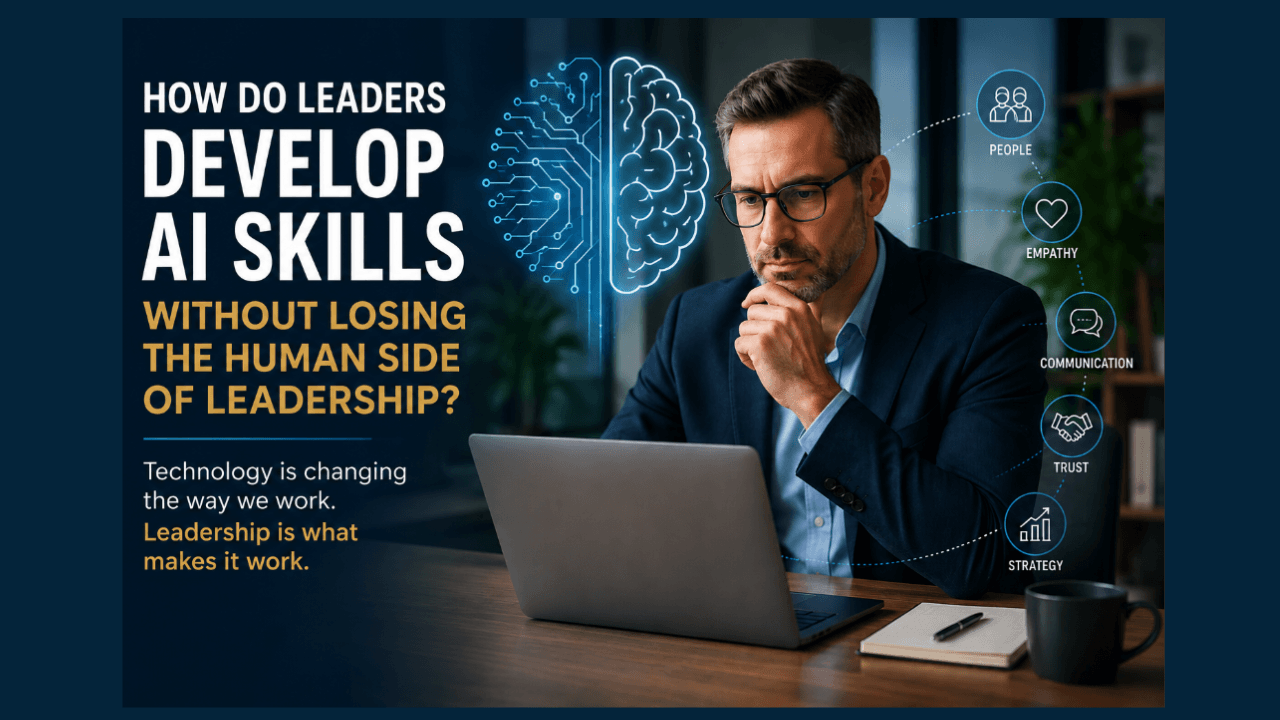
How can leaders develop AI skills without losing the human qualities that make them effective leaders?
The short answer is that the best leaders are not choosing between technology and people. They are learning how to use both effectively.
AI can improve efficiency, support decision-making, and help leaders process information more quickly. However, leadership still depends heavily on judgment, trust, communication, accountability, and relationships. Those responsibilities cannot simply be delegated to software.
The Direct Answer
Leaders should develop enough AI literacy to understand how the technology works, where it adds value, and where its limitations exist.
At the same time, they should continue strengthening the human leadership skills that drive performance, culture, and engagement.
In many organizations, AI is becoming a tool. Leadership remains a responsibility.
The leaders who succeed will be those who learn how to use technology to enhance their effectiveness rather than replace the human elements of leadership.
Why This Question Is Becoming More Important
Businesses are facing increasing pressure to improve productivity, reduce costs, and make better decisions faster.
AI tools can help accomplish many of those goals. Yet recent studies show that many organizations are implementing AI faster than they are preparing leaders and employees to use it effectively. In many cases, workers are teaching themselves rather than receiving structured guidance from leadership.
This creates a new challenge.
Leaders must not only learn AI themselves. They must also help their teams adapt to change while maintaining trust and alignment.
That requires leadership development, not just technology training.
What Most People Do Not Realize About AI and Leadership
Many business owners assume AI is primarily a technology issue.
In reality, it is often a leadership issue.
The most common barriers to successful AI adoption are not technical problems. They are organizational problems:
- Unclear priorities
- Poor communication
- Lack of employee buy-in
- Weak change management
- Fear of job displacement
- Insufficient training
These are all leadership challenges.
A company can purchase the best technology available, but if leaders cannot guide people through change, adoption often stalls.
The Human Skills That Become More Valuable as AI Expands
There is a misconception that AI will make leadership skills less important.
The opposite may be true.
As technology automates routine tasks, organizations increasingly rely on leaders who can provide clarity, context, and direction.
Some of the most valuable leadership skills include:
Communication
Employees need clear explanations about how technology affects their work.
Leaders who communicate effectively reduce uncertainty and build confidence.
Critical Thinking
AI can generate recommendations, but leaders still need to evaluate information and make decisions.
Technology supports judgment. It does not replace it.
Emotional Intelligence
Employees often have concerns about change, job security, and new expectations.
Understanding those concerns helps leaders build trust and engagement.
Coaching and Development
As roles evolve, employees need guidance to build new skills.
This is where leadership coaching and executive coaching often become valuable resources.
Strategic Thinking
AI can process data quickly, but it cannot fully understand business context, culture, customer relationships, or long-term vision.
Leaders remain responsible for strategic direction.
Research on emerging workplace skills continues to show strong demand for leadership, communication, collaboration, mentorship, and stakeholder management alongside AI-related capabilities.
When Leadership Coaching Can Help
Business coaching and executive coaching can help leaders navigate this transition more effectively.
A coach cannot teach every technical aspect of AI implementation.
However, coaching can help leaders:
- Clarify priorities
- Make better strategic decisions
- Communicate change effectively
- Improve accountability
- Lead through uncertainty
- Develop stronger leadership teams
- Balance technology initiatives with people development
In many organizations, the leadership challenges surrounding AI are far more complex than the technology itself.
That is where executive support and leadership coaching often create value.
When Coaching Is Not the Right Solution
Coaching is not a substitute for technical expertise.
If a company needs AI system implementation, software integration, cybersecurity architecture, or specialized technical training, consultants and technology experts may be the better resource.
Coaching can support leadership effectiveness during change, but it does not replace technical implementation expertise.
Understanding that distinction helps organizations make better decisions about the support they need.
How Focal Point Approaches This Differently
At Focal Point Business Coaching Ohio, the focus is not on chasing trends or promoting technology for its own sake.
The approach centers on helping business owners, executives, and leadership teams make thoughtful decisions that align with their goals.
As new technologies emerge, leaders often need a structured process to evaluate opportunities, assess risks, communicate effectively, and maintain organizational focus.
Focal Point’s coaching process uses proven business and leadership development frameworks to help leaders strengthen decision-making, accountability, communication, and execution.
Equally important, Focal Point coaches collaborate with one another, share best practices, and draw from a broader network of experience. If a prospective client is not the right fit, the goal is to help them find the right resource, whether that is within the Focal Point network or elsewhere.
Final Thoughts
Leaders do not need to become AI engineers to remain effective.
They do need to understand how technology is changing the workplace and how those changes affect their people, processes, and strategy.
The organizations most likely to succeed will not be those with the most technology.
They will be those with leaders who can combine technology, judgment, communication, and trust.
AI may change how work gets done.
Leadership still determines whether people choose to follow.
#BusinessCoaching
#ExecutiveCoaching
#LeadershipDevelopment
#LeadershipCoaching
#ArtificialIntelligence
#BusinessLeadership
#ExecutiveLeadership
#ManagementDevelopment
#FutureOfWork
#OhioBusinessCoaching