
Many leaders struggle with a difficult balance.
They want to be approachable, authentic, and emotionally intelligent, but they also worry that showing too much vulnerability could weaken confidence in their leadership.
This concern is especially common among executives, business owners, and managers responsible for making difficult decisions under pressure.
The honest answer is that vulnerability does not automatically undermine authority. In many cases, thoughtful vulnerability can strengthen leadership credibility, improve communication, and build trust inside organizations.
The key is understanding the difference between productive vulnerability and emotional instability.
Vulnerability and Oversharing Are Not the Same Thing
One of the biggest misconceptions in leadership development is the belief that vulnerability means sharing everything openly at all times.
It does not.
Effective leadership vulnerability is usually measured, intentional, and appropriate to the situation.
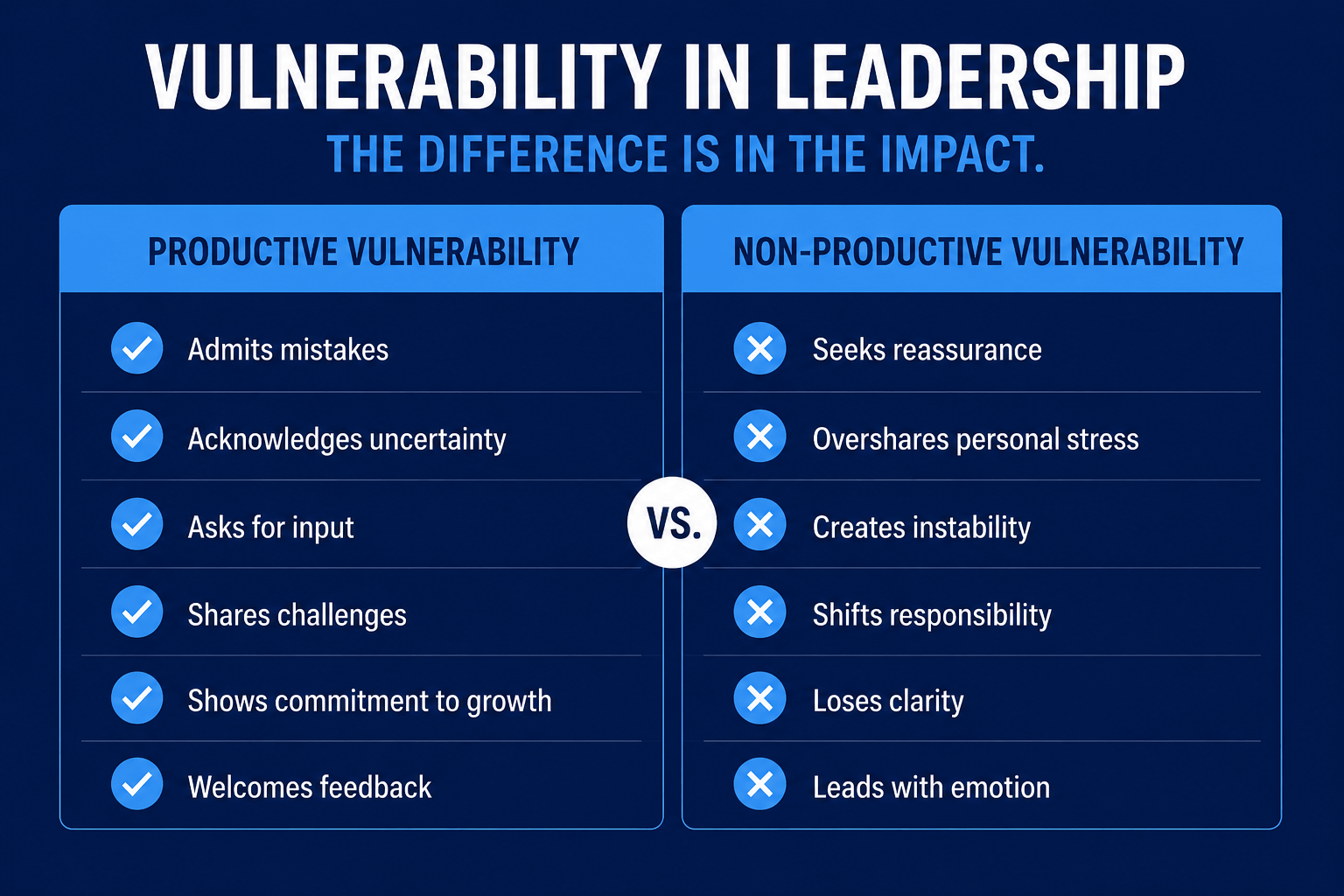
For example, leaders may acknowledge:
- Uncertainty during change
- Mistakes or misjudgments
- Areas where input is needed
- Challenges the organization is facing
- Personal growth opportunities
- Soliciting constructive feedback/criticism
That type of openness can increase trust because employees often recognize when leaders are pretending to have perfect answers.
At the same time, vulnerability becomes counterproductive when leaders:
- Constantly seek emotional reassurance from employees
- Overshare personal stress
- Create instability through emotional inconsistency
- Shift responsibility downward
- Lose clarity during difficult situations
Employees perform better under leaders who are honest and human, but also composed, accountable, and capable of making decisions.
Strong Leadership Often Requires Emotional Balance
One reason this topic is challenging is that leadership roles naturally involve pressure, uncertainty, and visibility.
Executives are expected to:
- Communicate clearly during uncertainty
- Make difficult decisions
- Maintain organizational confidence
- Handle conflict professionally
- Support teams emotionally
- Remain steady under pressure
That does not mean leaders must appear emotionless.
In reality, emotionally detached leadership can reduce trust just as much as emotional volatility.
Strong leadership often involves balancing authenticity with stability.
This balance is frequently explored in executive coaching and leadership coaching because many professionals were promoted based on technical skill or operational performance, not emotional communication training.
Employees Usually Respect Honest Leaders More Than Perfect Ones
Another misconception is that leaders lose authority whenever they admit mistakes or uncertainty.
In practice, many employees respond positively when leaders demonstrate accountability and self-awareness.
For example, leaders may strengthen trust by saying:
- “I underestimated this challenge.”
- “That decision did not produce the results I expected.”
- “I need better communication here.”
- “I do not have every answer yet, but here is our plan moving forward.”
These types of statements often create more credibility than defensiveness or artificial certainty.
What employees usually struggle with is not vulnerability itself, but inconsistency, confusion, avoidance, or lack of direction.
Vulnerability Without Accountability Can Become a Problem
While vulnerability can improve leadership trust, it is not universally positive in every form.
Leaders can unintentionally create problems when vulnerability is not paired with accountability and decision-making.
For example:
- Constant self-doubt may create uncertainty within teams
- Emotional inconsistency can reduce psychological stability
- Excessive transparency during crises may increase fear
- Public frustration without solutions can damage morale
This is why emotional intelligence in leadership is not simply about openness. It is also about judgment, timing, and communication discipline.
In leadership development and management coaching, professionals often work on learning how to communicate honestly while still providing direction and stability.
What Most Leaders Do Not Realize About Authority
Many professionals assume authority comes primarily from confidence and certainty or power and position.
In reality, leadership authority is often built through:
- Consistency
- Clarity
- Accountability
- Sound decision-making
- Emotional discipline
- Trustworthiness
- Communication quality
Leaders who acknowledge challenges realistically while remaining composed are often viewed as more credible than leaders who project constant certainty disconnected from reality.
This is especially important during periods of organizational stress or change.
Employees usually recognize when leaders are avoiding difficult truths. Transparent communication, when handled appropriately, often strengthens leadership credibility rather than weakening it.
Leadership Isolation Often Makes This Harder
Many executives struggle with vulnerability because leadership positions can become isolating.
Senior leaders may feel pressure to:
- Protect employee confidence
- Avoid appearing uncertain
- Solve problems independently
- Absorb organizational stress privately
Over time, this can create emotional exhaustion and communication challenges.
This is one reason executive support systems such as leadership coaching, peer advisory groups, and executive coaching relationships can become valuable.
These environments give leaders space to process challenges honestly without placing emotional burden directly onto employees or internal teams.
That distinction matters because leaders still need support themselves, even while supporting others.
Coaching Can Help Leaders Communicate More Effectively
Business coaching and executive coaching cannot eliminate the pressures of leadership.
However, structured coaching can help professionals improve:
- Emotional intelligence
- Communication clarity
- Leadership presence
- Decision-making confidence
- Conflict management
- Organizational communication
In many cases, leaders are not struggling with vulnerability itself. They are struggling with how to communicate authentically while maintaining stability and authority.
Thoughtful, personalized coaching can help leaders. can help leaders navigate those situations more intentionally.
That does not mean coaching provides scripted leadership behavior or universal formulas. Leadership communication depends heavily on organizational culture, team dynamics, and the specific challenges involved.
How Focal Point Approaches Leadership Communication
Focal Point Business Coaching Ohio works with executives, business owners, and leadership teams using structured coaching systems designed to improve communication, leadership effectiveness, accountability, and organizational clarity.
Part of leadership development often involves helping leaders navigate difficult communication challenges, including:
- Organizational uncertainty
- Conflict management
- Team trust
- Delegation
- Accountability conversations
- Executive communication
Focal Point coaches collaborate across a broader coaching network, allowing leaders to benefit from shared leadership insights and structured methodologies rather than isolated advice alone.
At the same time, coaching is approached realistically. There is no single communication style that works for every leader or organization.
Effective leadership communication usually depends on context, emotional discipline, and the ability to balance transparency with responsibility.
Vulnerability Works Best When It Is Grounded in Stability
Leaders do not need to appear perfect to maintain authority.
In many organizations, trust grows when leaders communicate honestly, acknowledge challenges realistically, and remain accountable during uncertainty.
The goal is not emotional performance or forced openness.
The goal is to develop leadership communication that is authentic, steady, and responsible enough to build trust without creating instability. For many professionals, that balance becomes an important part of long-term leadership growth.