
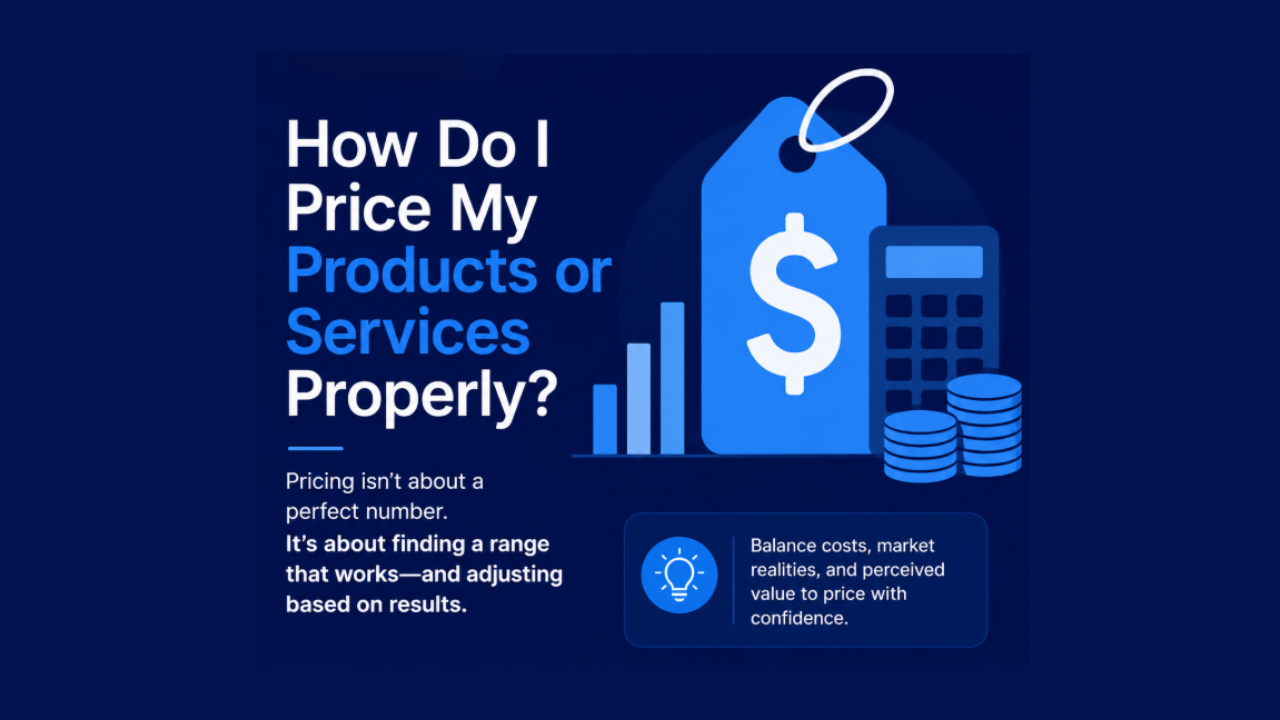
Pricing is one of the most difficult decisions for business owners because it sits at the intersection of value, cost, and market perception. Many worry about setting prices too high and losing business, or too low and undermining profitability. It is a valid concern, and one that comes up often in business coaching and small business advice conversations.
The reality is that pricing is not about finding a perfect number. It is about finding a range that works, then adjusting based on results and feedback.
The Direct Answer
To price products or services properly, a business needs to balance three things: its costs, the realities of the market, and how customers perceive the value being delivered. If any one of these is ignored, pricing tends to become either unsustainable or ineffective.
There is no universal formula that guarantees success. Pricing is a decision that improves over time as the business gains more clarity and data.
The Three Core Factors That Drive Pricing
At the most basic level, pricing has to work financially. A business needs to understand what it actually costs to deliver its product or service, including both direct expenses and overhead. Without that clarity, it is possible to grow revenue while quietly losing money. This is more common than many owners expect.
At the same time, pricing cannot exist in a vacuum. Customers compare options, even if they are not doing so consciously. They have a sense of what similar products or services cost, and pricing that falls too far outside those expectations can create resistance. This does not mean a business must match competitors, but it does need to understand the environment it operates in.
The third factor is perceived value, which is often the most misunderstood. Customers are not only paying for the product or service itself, but for the outcome, the experience, and the trust they have in the provider. Two businesses offering something similar can charge very different prices if one communicates its value more clearly or delivers a stronger overall experience.
Common Pricing Approaches
Many businesses begin with cost-based pricing because it feels straightforward. They calculate expenses, add a margin, and set a price. While this can provide a useful baseline, it often ignores how customers actually make decisions. As a result, businesses may underprice without realizing it or struggle to justify higher prices.
Market-based pricing takes a different approach by looking outward. It aligns pricing with what competitors are charging, which can help ensure that pricing feels reasonable to customers. However, this approach can lead to a lack of differentiation. If every business follows the market, it becomes harder to stand out.
Value-based pricing is often discussed in business growth coaching because it focuses on the results delivered to the customer rather than the cost of delivery. This can lead to stronger margins, but it is also more difficult to execute. It requires a clear understanding of the customer’s priorities and the ability to communicate value effectively.
In practice, most businesses use a combination of these approaches rather than relying on just one.
Common Misconceptions
One of the most persistent misconceptions is that lowering prices will automatically attract more customers. While it may increase volume, it does not guarantee profitability. In some cases, it attracts customers who are more price-sensitive and less loyal.
Another misconception is that higher prices require a dramatically better product or service. While quality matters, pricing is also influenced by positioning and perception. Businesses that clearly communicate their value often have more flexibility in pricing than those that do not.
It is also common to assume there is a single correct price waiting to be discovered. In reality, pricing is dynamic. It should evolve as the business grows, the market shifts, and the value proposition becomes clearer.
The Tradeoffs Most Owners Overlook
Every pricing decision comes with tradeoffs. Lower prices may increase sales volume, but they can also increase workload and reduce margins. Higher prices may limit volume, but they can improve profitability and allow for better service or delivery.
These decisions also influence how a business is perceived in the market. Pricing sends a signal, whether intentional or not, about quality, positioning, and target audience. This is why pricing is often part of broader leadership development and management coaching discussions, not just financial analysis.
What Most People Do Not Realize
Many pricing challenges are not actually caused by the price itself. They are often tied to unclear positioning or weak communication of value. If customers frequently question the price, it may indicate that they do not fully understand what they are getting or why it matters.
This is where executive coaching and business coaching can be useful. Instead of focusing only on the number, the conversation often shifts to how the business presents its value and how confidently it stands behind its pricing.
When Coaching Helps with Pricing
Coaching can be helpful when pricing decisions feel inconsistent or reactive, or when profitability is unclear despite steady revenue. It can also provide structure when a business is growing but margins are tightening, or when the owner lacks confidence in how prices are set and adjusted.
A structured approach can help bring clarity to the decision-making process, even though it does not remove uncertainty entirely.
When Coaching Does Not Help
There are also situations where coaching alone is not enough. If financial data is incomplete or unreliable, it becomes difficult to make informed pricing decisions. Similarly, if the market does not support a certain pricing level, no amount of strategy will change that reality.
In some cases, the underlying issue is a lack of a clear value proposition. Until that is addressed, pricing will continue to feel uncertain.
How Focal Point Business Coaching Approaches Pricing
Focal Point Business Coaching Ohio approaches pricing as part of a broader system rather than an isolated tactic. The focus is on helping business owners understand their numbers, evaluate their market position, and clarify the value they deliver.
Coaches use structured frameworks to guide these discussions, which helps reduce guesswork and improve consistency. They also collaborate and share insights across their network, which can provide a wider perspective on common pricing challenges.
Importantly, the goal is not to push prices in a specific direction. It is to help ensure that pricing decisions are intentional and aligned with the overall business strategy. If the challenge extends beyond coaching, such as needing detailed financial analysis or market research, the emphasis is on helping the client find the right support.
The Bottom Line
Pricing products or services properly is not about guessing the right number. It is about understanding costs, recognizing market dynamics, and communicating value in a way that supports sustainable growth.
Business coaching and executive support can bring structure and clarity to this process, but they cannot replace the need for accurate information and thoughtful decision-making.
For most business owners, better pricing begins with a deeper understanding of their business and the customers they serve.