
Scaling a business is often seen as the goal, but many owners and executives discover that growth can create as many problems as it solves. Revenue increases, but so do complexity, costs, and pressure on systems and people.
This is why the question of sustainable scaling comes up frequently in business coaching and executive coaching. Growth alone is not enough. It has to be manageable and profitable.
The Direct Answer
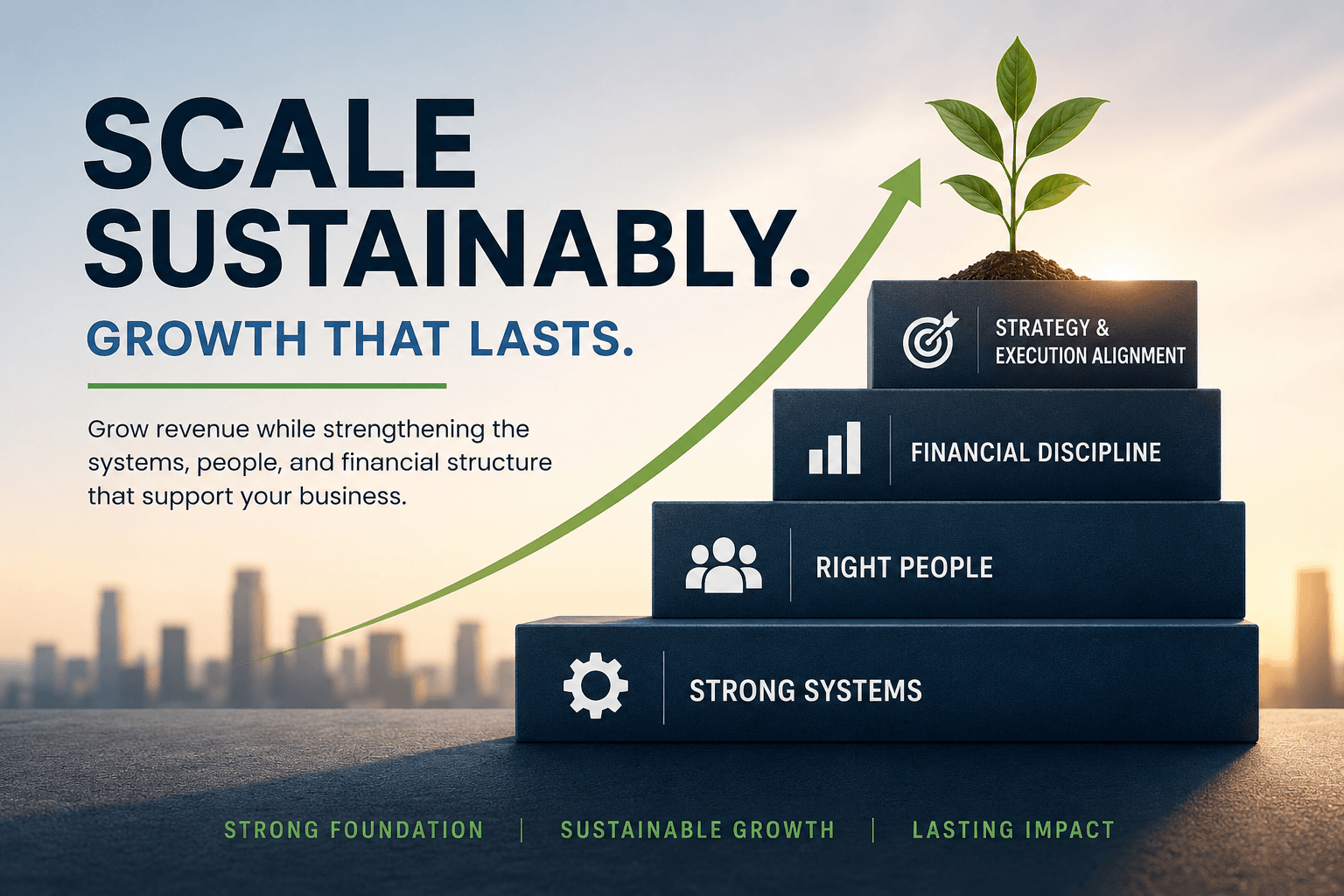
The best way to scale sustainably is to grow revenue while strengthening the systems, people, and financial structure that support that growth.
Sustainable scaling is not about how fast a business grows. It is about whether the business can handle that growth without breaking down operationally or financially.
Why Scaling Often Becomes Unsustainable
Many businesses focus on increasing sales without improving the underlying structure. This creates strain.
As demand increases:
- Processes that once worked begin to fail
- Communication becomes inconsistent
- Costs rise faster than expected
- Leadership becomes stretched
Without the right foundation, growth amplifies weaknesses instead of creating stability.
The Core Elements of Sustainable Scaling
Sustainable growth tends to come from improving a few key areas in parallel rather than focusing on just one.
A business needs clear and repeatable processes. When tasks depend too heavily on individuals, scaling becomes difficult. Systems create consistency and reduce variability as the business grows.
It also requires the right people in the right roles. Hiring alone does not solve capacity issues. Roles need to be clearly defined, and leadership needs to evolve to support a larger team. This is where leadership development becomes critical.
Financial discipline is another key factor. Growth often requires investment, but without a clear understanding of margins, cash flow, and cost structure, scaling can create financial risk rather than stability.
Finally, there needs to be alignment between strategy and execution. Growth efforts should be intentional, not reactive. This is a common focus in business growth coaching and management coaching.
The Benefits of Scaling Sustainably
When scaling is approached deliberately, businesses tend to experience more predictable performance. Operations become more stable, and decision-making becomes clearer because there is a stronger foundation in place.
Sustainable growth also reduces stress on leadership. Instead of constantly reacting to problems, leaders can focus on direction and improvement.
The Tradeoffs and Challenges
Sustainable scaling is often slower than aggressive growth strategies. It requires patience and discipline, which can be difficult in competitive environments.
It also requires investment in areas that do not always produce immediate returns, such as systems, training, and leadership development.
In some cases, opportunities may be delayed or declined in order to maintain stability. This can feel counterintuitive, especially for growth-focused leaders.
Common Misconceptions
One common misconception is that scaling is primarily about increasing sales. In reality, sales are only one part of the equation. Without operational and financial alignment, increased sales can create more problems than they solve.
Another misconception is that hiring more people will automatically support growth. Without clear structure and leadership, adding people can increase complexity without improving performance.
There is also a belief that faster growth is always better. In practice, growth that outpaces a company’s ability to manage it often leads to setbacks.
What Most People Do Not Realize
Sustainable scaling often requires the business owner or executive to change their role.
As the business grows, leaders need to spend less time on execution and more time on strategy, delegation, and leadership. This shift is not always easy, especially for those who built the business by being closely involved in day-to-day operations.
This is why executive coaching and leadership coaching are often part of scaling conversations. The business cannot grow sustainably if leadership does not evolve with it.
When Coaching Helps with Scaling
Business coaching can be valuable when a company is experiencing growth but struggling to manage it effectively. It can also help when priorities are unclear, or when leadership is stretched between strategic and operational responsibilities.
A structured approach can help identify where breakdowns are occurring and how to address them systematically.
When Coaching Does Not Help
Coaching has limitations in scaling situations. If the business model itself is not viable, or if there is insufficient demand, coaching will not solve those issues.
Similarly, if leadership is unwilling to delegate or change how they operate, scaling will remain difficult regardless of strategy.
How Focal Point Business Coaching Approaches Sustainable Growth
Focal Point Business Coaching Ohio approaches scaling through structured systems that address both strategy and execution.
Rather than focusing only on revenue growth, coaches work with clients to evaluate operations, financials, and leadership capacity. The goal is to ensure that each part of the business can support the next stage of growth.
Coaches collaborate and share insights, which can provide broader perspective on common scaling challenges. This allows clients to benefit from patterns and lessons beyond a single business experience.
Importantly, the focus is on building a business that can sustain growth, not just achieve it. If a situation requires expertise outside of coaching, the emphasis is on helping the client find the right support.
The Bottom Line
The best way to scale sustainably is to grow with intention while strengthening the systems, people, and financial structure behind the business.
Business coaching and executive support can help bring clarity and structure to this process, but they do not replace the need for disciplined execution.
Sustainable growth is not the fastest path. It is the one that allows the business to keep growing without losing stability.