
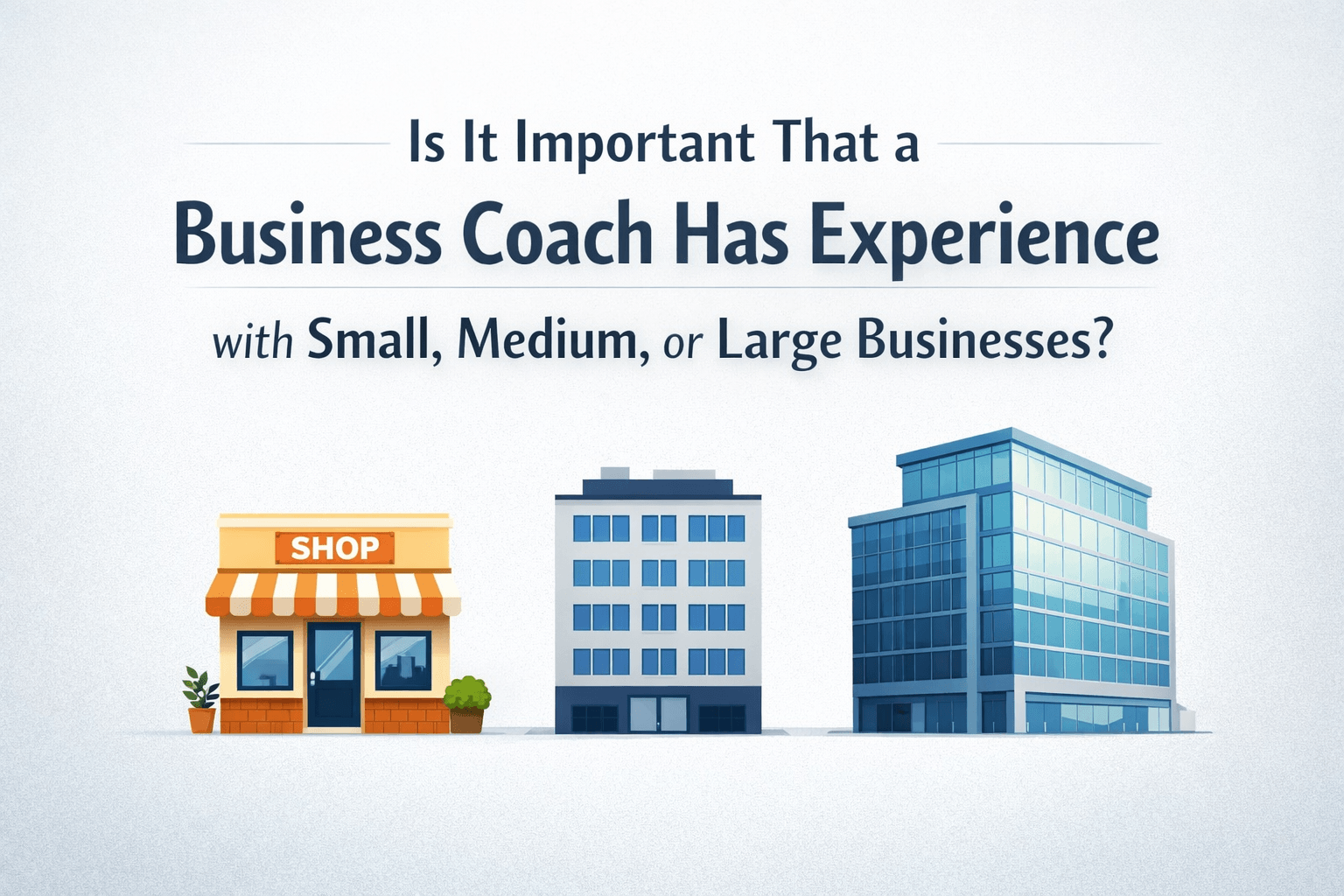
Many people searching for business coaching or executive coaching wonder whether their coach needs to have experience in a company of a similar size. It is a fair question. Running a five-person company is very different from leading a 500-person organization, and the stakes, structure, and challenges are not the same.
The short answer is yes, experience with a similar business size can matter, but it is not the only factor, and in some cases, it is not even the most important one. A coach’s familiarity with businesses of a similar size can improve relevance and speed of insight. However, what matters more is whether the coach uses a structured approach, understands core business principles, and can adapt those principles to the client’s situation.
In other words, size-specific experience helps, but it does not replace good coaching.
Why Business Size Experience Can Be Valuable
Different business sizes come with different realities. A coach who understands those differences can often get to meaningful conversations faster.
Small businesses
Owners are usually close to daily operations. Cash flow, hiring, and time management dominate decision-making.
A coach with small business experience is more likely to:
- Focus on practical execution
- Understand resource constraints
- Help prioritize quickly
Mid-sized businesses
These companies often struggle with structure, delegation, and scaling systems.
Relevant coaching experience here can help with:
- Building leadership layers
- Improving accountability
- Creating repeatable processes
Large businesses or enterprises
Executives deal more with strategy, culture, and organizational complexity.
A coach experienced at this level may bring:
- Strong leadership development frameworks
- Experience with cross-functional alignment
- Executive-level communication strategies
Where This Thinking Can Go Wrong
One common misconception is that a coach must have worked in a business exactly like yours to be effective. That is not always true.
Business coaching is not just about sharing past experience. It is about helping clients think more clearly, make better decisions, and execute consistently. Many of those skills transfer across industries and company sizes. A coach who relies only on personal experience may actually be limited. They may default to “what worked before” instead of what fits the current situation.
While size-specific experience can help, several factors tend to have a bigger impact on outcomes.
A structured coaching system
Coaches who use proven frameworks can guide clients through planning, execution, and accountability more consistently than those who rely on intuition alone.
Adaptability
No two businesses are identical. A good coach adjusts their approach rather than forcing a one-size-fits-all solution.
Business fundamentals
Core principles like cash flow management, leadership development, and strategic planning apply across all business sizes.
Accountability and follow-through
Coaching is not just about ideas. It is about implementation. A coach who drives action often delivers more value than one with highly specific past experience.
When Size-Specific Experience Matters Most
There are situations where specialization becomes more important.
- Highly complex organizations with multiple layers of leadership
- Businesses going through rapid scaling or restructuring
- Owners or executives facing challenges they have never encountered before
- Industries with strict regulatory or operational requirements
In these cases, relevant experience can shorten the learning curve and reduce risk.
When It Matters Less
In many cases, especially with small business advice and early-stage growth, the fundamentals matter more than the coach’s background.
- Early-stage entrepreneurs building structure
- Owners needing clarity, focus, and accountability
- Teams working on leadership development basics
- Businesses trying to improve execution rather than strategy
Here, a strong coaching process often outweighs specific size experience.
What Most People Do Not Realize
Many effective business coaches do not rely on their own past business alone. Instead, they draw from a broader network, shared knowledge, and tested systems.
This can actually be an advantage.
Rather than offering one perspective, they bring patterns from many businesses. This allows them to identify blind spots and opportunities that a single-company background might miss.
How We See It
Focal Point Business Coaching Ohio emphasizes structured systems and collaborative learning among its coaches. Instead of relying solely on one coach’s personal experience:
- Coaches use established frameworks for business growth coaching and leadership coaching
- They collaborate and share insights across a broader network
- They focus on adapting proven principles to each client’s situation
This approach helps balance real-world experience with consistency and depth.
Importantly, if a client’s needs fall outside a coach’s expertise, the goal is to help them find the right fit rather than force a match. Not every coaching relationship is the right one, and recognizing that is part of responsible executive support.
The Bottom Line
Experience with a specific business size can be helpful, but it should not be the deciding factor on its own.
A strong coaching relationship depends more on:
- The coach’s process
- Their ability to adapt
- Their focus on execution and accountability
The most effective business coaching combines relevant experience with structured thinking and practical application.
For someone evaluating coaching options, the better question may not be “Have they worked with a business my size?” but rather “Can they help me make better decisions and follow through consistently?”