
Have you reached a point in your career where your strong management skills are no longer enough to move forward?
Are you an excellent at solving problems, managing projects, or overseeing teams, yet still feel overlooked for executive leadership roles?
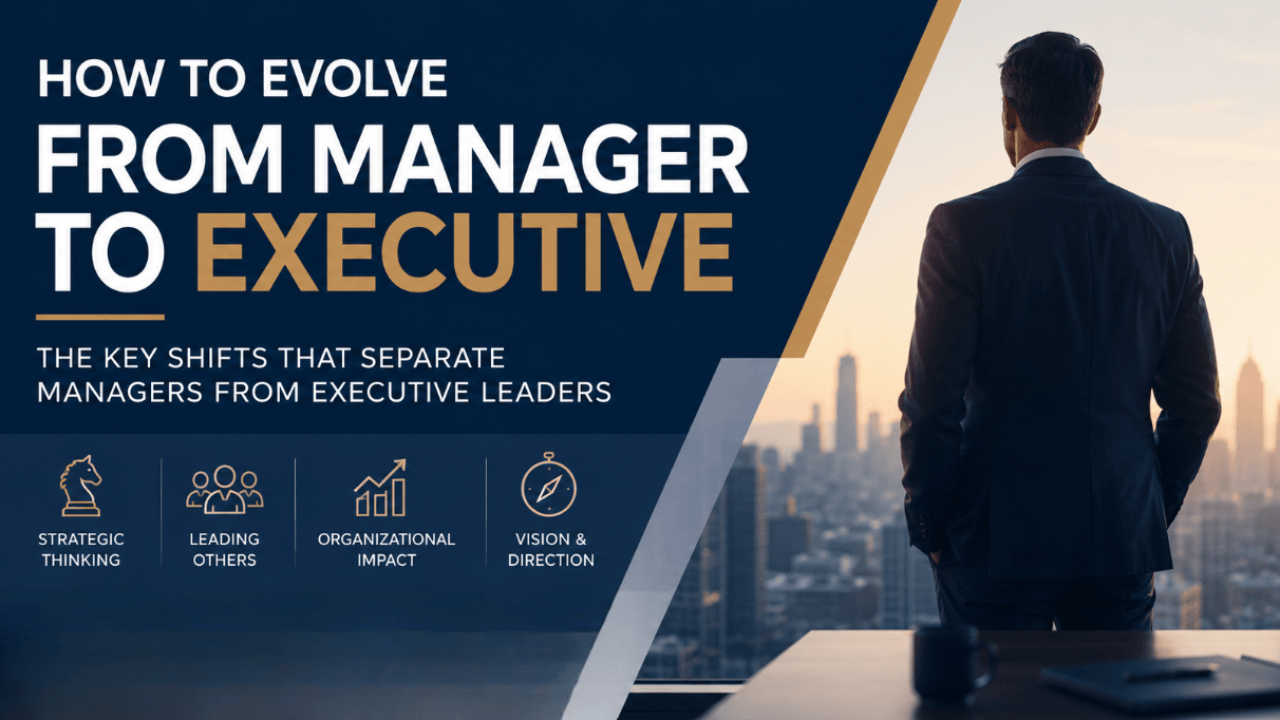
You aren’t the first professional to ask an important question: how do I evolve from manager to executive?
The short answer is that the transition usually requires shifting from operational thinking to organizational leadership. That change is less about authority or title and more about perspective, decision-making, and influence.
Managers Focus on Execution. Executives Focus on Direction.
Managers are typically responsible for execution.
They oversee people, projects, timelines, budgets, and performance. Their role is often centered around maintaining consistency, solving immediate problems, and ensuring work gets completed effectively.
Executives still care about execution, but their primary responsibility is broader.
Executive leadership usually involves:
- Long-term strategy
- Organizational alignment
- Leadership development
- Cross-functional decision-making
- Financial oversight
- Culture and communication
- Risk management
- Prioritization at scale
In many organizations, strong managers struggle to become executives because they continue operating at a tactical level long after the role requires strategic thinking.
This is one reason leadership coaching and executive coaching often focus heavily on mindset, communication, and decision-making rather than technical expertise alone.
One of the Biggest Shifts Is Letting Go of Control
Many managers advance because they are highly capable problem-solvers.
They know the details. They respond quickly. They fix issues personally.
Those strengths can become limitations at the executive level.
Executives cannot realistically control every detail across an organization. Instead, they must learn to:
- Delegate authority
- Trust leadership teams
- Make decisions with incomplete information
- Develop other leaders
- Focus on priorities instead of tasks
- Think beyond immediate operational issues
This transition is uncomfortable for many professionals because success as a manager often comes from personal involvement, while success as an executive depends more on organizational influence and strategic clarity.
Communication Changes at the Executive Level
Another major difference between management and executive leadership is communication.
Managers often communicate within departments or teams. Executives communicate across entire organizations, leadership groups, boards, clients, and stakeholders.
That requires a different skill set.
Executives are expected to:
- Communicate vision clearly
- Align teams around priorities
- Handle conflict diplomatically
- Lead through uncertainty
- Influence without micromanaging
- Simplify complex decisions
Many professionals underestimate how important communication becomes at senior leadership levels.
In practice, executive presence is often less about personality and more about clarity, consistency, and emotional discipline under pressure.
Technical Skill Alone Rarely Creates Executive Leaders
One common misconception is that the best technical performers naturally become strong executives.
That is not always true.
Organizations frequently promote individuals based on operational excellence, only to discover that executive leadership requires entirely different strengths.
Strong executives usually develop skills in areas such as:
- Strategic planning
- Financial literacy
- Organizational leadership
- Coaching and mentoring
- Team alignment
- Decision-making under uncertainty
- Leadership development
- Accountability systems
This is where executive support and management coaching can become valuable. Coaching does not replace experience, but it can help leaders identify blind spots and accelerate professional growth.
What Most People Do Not Realize About Executive Leadership
One reality many professionals discover late is that executives are rarely evaluated solely on their own performance.
They are evaluated on the performance of the organization around them.
That means executives must consistently think beyond personal productivity and focus instead on:
- Building capable teams
- Creating sustainable systems
- Improving communication structures
- Developing future leaders
- Managing organizational priorities
This shift can be difficult for high-performing managers who are used to being personally recognized for direct contributions.
At the executive level, success becomes more collective and less individual.
Executive Coaching Can Help, but It Is Not a Shortcut
Executive coaching can help leaders improve self-awareness, communication, strategic thinking, and leadership effectiveness.
However, coaching is not a substitute for experience or organizational readiness.
Some professionals pursue executive coaching expecting quick promotions or immediate career transformation. That is not how leadership development typically works.
Progress often depends on factors such as:
- Organizational structure
- Available leadership opportunities
- Industry conditions
- Company culture
- Individual adaptability
A strong coaching relationship can provide perspective, accountability, and leadership development support, but long-term growth still requires consistent application over time.
Not All Executive Coaching Approaches Are the Same
One thing professionals often overlook is that executive coaching varies significantly between coaches and coaching systems.
Some coaching focuses heavily on motivation or personal mindset. Other approaches are more structured and business-oriented.
Structured business coaching and leadership coaching may include:
- Strategic leadership frameworks
- Communication assessments
- Accountability systems
- Leadership behavior analysis
- Decision-making processes
- Team development strategies
The effectiveness of coaching often depends on the quality of the process and the willingness of the leader to engage honestly with feedback.
How Focal Point Approaches Leadership Development
Focal Point Business Coaching Ohio uses structured coaching systems designed to support leadership development, executive growth, and organizational effectiveness.
Rather than relying solely on motivational concepts, the approach emphasizes practical leadership challenges such as communication, accountability, strategic alignment, and decision-making.
Focal Point coaches also collaborate and share insights across the broader coaching network, allowing leaders to benefit from collective experience and structured methodologies.
At the same time, coaching is treated as a professional development process rather than a guaranteed solution. Not every leadership challenge can be solved through coaching alone, and not every coaching approach is the right fit for every professional or organization.
That level of transparency is important in executive development.
Evolving Into an Executive Takes More Than a Promotion
The transition from manager to executive is rarely automatic.
It usually requires learning how to think more strategically, communicate more effectively, lead through other people, and make decisions with broader organizational impact.
For many professionals, the challenge is not intelligence or work ethic. It is learning how to shift from managing activity to leading direction.
That evolution takes time, feedback, self-awareness, and often outside perspective.
The goal is not simply to gain a new title. It is to become capable of leading at a higher level with clarity, consistency, and sound judgment.