
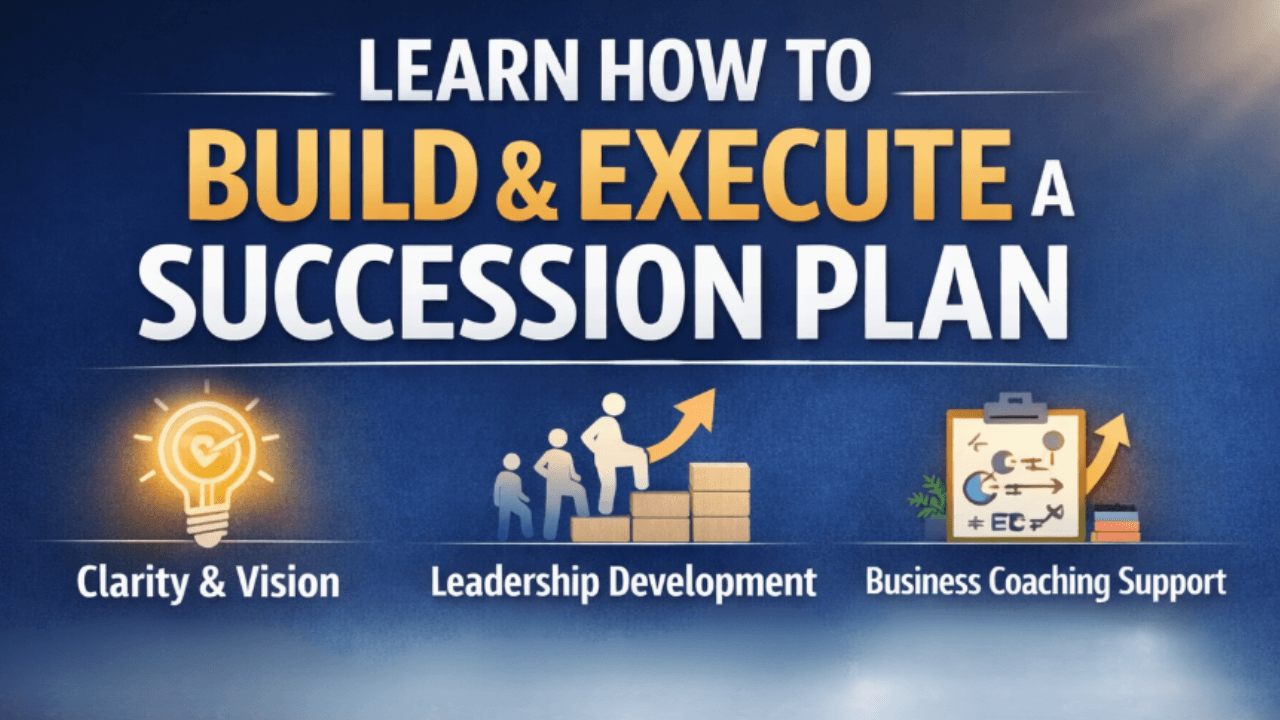
What Steps Should I Take to Build and Execute a Succession Plan?
Most business owners do not wake up one morning excited to build a succession plan.
The question usually surfaces quietly. A peer retires. A health scare happens. A key employee leaves. Growth accelerates and the founder realizes everything still runs through them.
At that moment, succession stops being theoretical. It becomes practical.
The direct answer is this: building and executing a succession plan requires clarity about the future, leadership development, documented systems, financial coordination, and a structured transition timeline. It is not a single document. It is a disciplined process.
It Starts With a Hard Question: What Is the End Game?
Before discussing successors or timelines, a leader must answer a more personal question.
What does transition actually look like?
Is the goal to:
- Retire fully within five years
- Step into a board or advisory role
- Transfer leadership to a family member
- Promote an internal executive
- Prepare the company for sale
Many succession plans fail because the owner never clarified the destination. Without that clarity, every decision feels temporary.
Succession planning in business coaching often begins with this alignment conversation. If the vision is unclear, the strategy will be fragmented.
The Reality Most Owners Discover
When leaders examine their organization honestly, a common pattern appears.
They are the hub of major client relationships, strategic decisions, financial oversight, problem resolution and culture reinforcement. Yes, they are valuable, but the risk to the company is huge. If the company cannot operate independently for 30 days, succession planning must begin with leadership development and operational structure.
This is where executive coaching and management coaching intersect with succession. Before transferring ownership, leaders must transfer capability.
Developing a Successor Is a Multi-Year Commitment
Naming a successor is easy. Preparing one is not.
Future leaders need:
- Strategic decision-making discipline
- Financial fluency
- Clear authority boundaries
- Executive presence
- Accountability systems
Many small business owners underestimate how long this development takes. Leadership readiness is built through structured feedback, real responsibility, and measured growth.
Business growth coaching during this phase is less about expansion and more about sustainability.
Document What Lives in Your Head
A surprising moment for many executives is realizing how much institutional knowledge is undocumented.
Key processes often exist only in memory:
- Sales conversations
- Vendor negotiations
- Hiring decisions
- Financial controls
- Client retention strategies
A transferable business requires documented systems. Succession planning forces clarity.
This is often one of the most valuable byproducts of the process. Even if the transition is years away, the business becomes stronger immediately.
The Financial and Legal LayerLeadership transition is only part of the equation.
Ownership transfer requires:
- Valuation analysis
- Tax planning
- Legal agreements
- Buy sell provisions
- Estate coordination
Executive support from a coach helps align decisions, but attorneys and financial advisors handle technical execution. Succession planning works best when these disciplines collaborate.
Communication Is Where Many Plans Break Down
Even with structure in place, transitions fail when communication is vague.
Employees need:
- Clear timelines
- Defined authority changes
- Confidence in leadership continuity
Clients need reassurance.
Uncertainty creates more instability than change itself.
The Pros and the Friction
The benefits of early succession planning:
- Preserves company value
- Reduces dependency risk
- Strengthens leadership bench
- Improves operational clarity
- Creates peace of mind
The challenges:
- It forces uncomfortable conversations
- It exposes gaps in leadership readiness
- It requires time and discipline
- It can temporarily slow reactive decision-making
That friction is not a sign to stop. It is evidence the work matters.
When Coaching Helps and When It Does Not
Leadership coaching is particularly valuable when:
- The owner struggles to delegate
- Internal leaders need structured development
- Decision authority is unclear
- Accountability systems are inconsistent
Coaching is less effective when:
- There is no willingness to share control
- The focus is solely on a quick sale
- Financial and legal preparation is ignored
Succession is not solved by motivation. It is solved by structure.
How Focal Point Approaches Succession Planning
At Focal Point Business Coaching Ohio, succession planning is integrated into structured business coaching and leadership development systems.
Coaches:
- Use proven planning frameworks
- Develop leadership capability with measurable accountability
- Help document strategy and execution rhythms
- Collaborate across the coaching team to share experience and perspective
If a client’s situation requires specialized exit advisory, investment banking, or complex legal structuring, they are encouraged to engage the appropriate professionals. Coaching strengthens leadership and operational readiness. It does not replace technical advisors.
Who Should Consider Focal Point Business Coaching Ohio
Focal Point may be a strong fit for:
- Owners planning transition within three to seven years
- Organizations developing internal successors
- Leadership teams seeking structured executive coaching
- Businesses that want clarity, accountability, and measurable growth
Who May Be Better Served Elsewhere
Other options may be more appropriate if:
- The goal is immediate transaction execution only
- There is no intention to build internal leadership capacity
- The owner is unwilling to redistribute decision authority
- The need is strictly legal structuring
In those cases, a transaction advisor or attorney may be the primary resource.
Final Reflection
Succession planning is rarely urgent until it suddenly is.
The leaders who approach it strategically transform it from a contingency exercise into a growth initiative. The organization becomes less dependent, more disciplined, and more valuable long before any transition occurs.
A strong succession plan is not about leaving. It is about building something that can endure.