
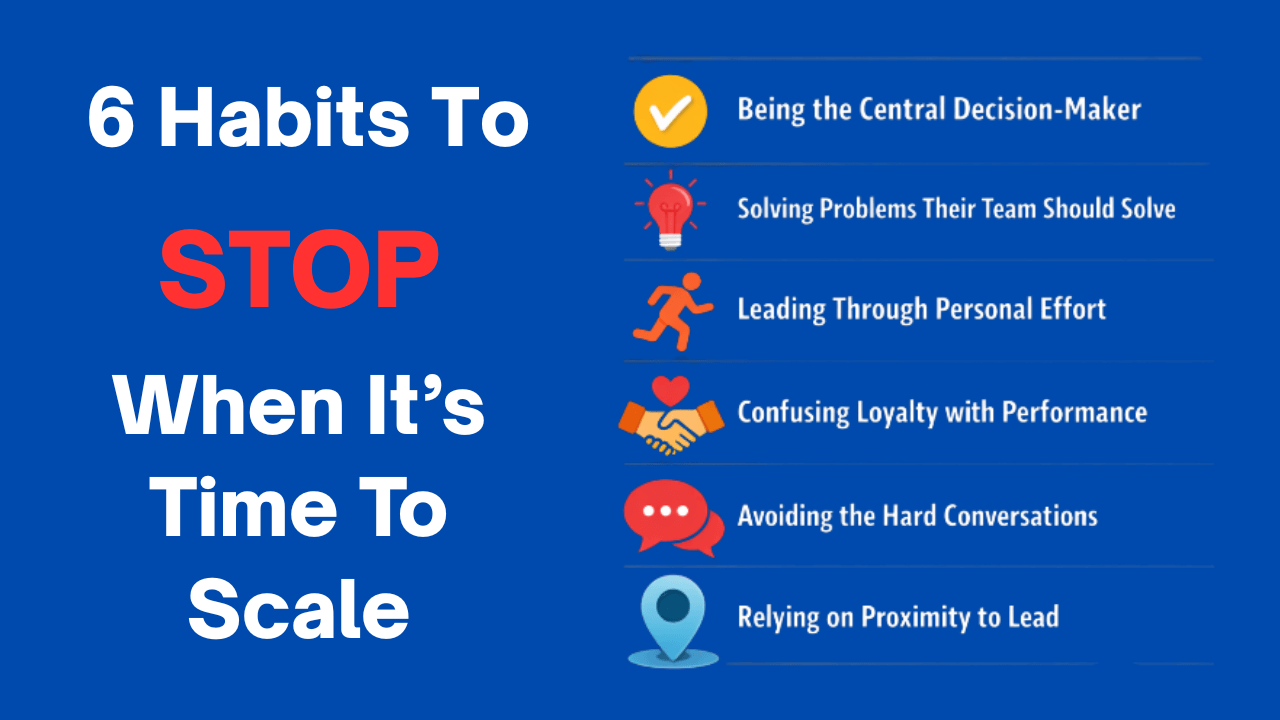
Growth changes everything. You may be familiar with the phrase, “What got you here, won’t get you there”! If not, or if you haven’t figured out how that is going to impact you and your business as you navigate your company’s growth, then this is for you.
The leadership habits that helped you win early, moving fast, staying close to every decision, and being the go-to problem solver often become the very things that slow an organization down as it scales.
This is one of the hardest transitions for leaders and leadership teams. Not because leaders aren’t capable, but because success rewards behaviors that eventually need to change. This transition might need to be revisited multiple times during the organization’s continued growth.
The most effective leaders don’t just learn new skills as they scale. They intentionally stop doing certain things, even when those things once worked very well. Below are the most common (and costly) habits successful leaders let go of as their organizations grow, and what should take their place.
1. They Stop Being the Central Decision-Maker
In early-stage companies, centralized decision-making is efficient. Fewer people, fewer variables, faster execution.
At scale, when leaders insist on approving everything, they become a bottleneck.
- Decisions slow down
- Teams hesitate instead of owning outcomes
- Leaders become overwhelmed, while others are underutilized
What replaces it:
Clear decision rights, trusted leaders, and defined ownership.
Strong leaders don’t disappear from decisions, but they stop being the default decision-maker and start being the designer of decision-making systems.
2. They Stop Solving Problems Their Team Should Solve
Many leaders are promoted because they are excellent problem solvers. That strength can quietly turn into a liability. When leaders jump in too quickly:
- Team capability stalls
- Confidence erodes
- Leaders stay stuck in the weeds
What replaces it:
Coaching and developing their team instead of fixing.
Great leaders ask better questions:
- “What have you tried?”
- “What do you think the real issue is?”
- “What decision would you make if I weren’t here?”
This shift is at the heart of executive coaching—helping leaders move from heroic problem solver to multiplier of capability.
3. They Stop Leading Through Personal Effort
On a small scale, effort equals impact. On a larger scale, effort without leverage equals burnout. The rest of the team perceives a lack of trust from the leader. Naturally, they begin to hold back, waiting for the “boss” to make the decisions. Leaders in this position often feel overwhelmed and frustrated with the team for not stepping up. The ultimate result is a leader who is:
- Working longer hours with diminishing returns
- Creating dependency instead of autonomy
- Feeling indispensable, and exhausted
What replaces it:
Systems, structure, and repeatability.
Successful leaders focus on:
- Clear operating rhythms
- Defined expectations
- Scalable processes that don’t rely on personality or proximity
This is where business coaching and leadership development intersect: aligning strategy, structure, and leadership behavior so growth doesn’t depend on a few key individuals.
4. They Stop Confusing Loyalty with Performance
As organizations grow, long-standing relationships can blur accountability. It’s tempting to believe that because a person was effective while the company was small, they’ll be able to figure out how to be effective as it grows. Leaders who avoid addressing performance issues with these long term employees often tell themselves:
- “They’ve been here since the beginning”
- “They’re trying hard”
- “I don’t want to damage morale”
In reality, unclear standards do more damage than honest conversations.
What replaces it:
Clear expectations, measurable outcomes, and consistent accountability.
Strong leaders learn to:
- Separate appreciation from performance evaluation
- Address issues early, not after frustration builds
- Create fairness through clarity
Executive coaching often supports leaders here because knowing what to do is easier than actually doing it.
5. They Stop Avoiding the Hard Conversations
At scale, avoidance enables the deficiencies to compound. Ignoring the problems never results in them correcting themselves.
Unspoken tension at the leadership level shows up as:
- Conflicting priorities
- Mixed messages to teams
- Cultural drift
High-performing leaders don’t wait for conflict to resolve itself.
What replaces it:
Direct, respectful, timely conversations.
This doesn’t mean being harsh, it means being clear and specific about what is acceptable and what it not. At the same time, successful leaders address the behavior without attacking the person.
Leadership teams that scale well build the muscle to:
- Address misalignment quickly
- Give and receive real feedback
- Resolve issues without escalation or politics
6. They Stop Relying on Proximity to Lead
When everyone sat in one room, leadership by presence worked. As the organization grows, adds more people and outgrows the ‘one room business’ it doesn’t.
Leaders who rely on:
- Being in every meeting
- Hearing things “through the grapevine”
- Managing by visibility
…eventually lose control rather than gain it.
What replaces it:
Intentional communication, aligned leadership behaviors, and shared standards.
This is where leadership teams either evolve together or fragment.
The Real Shift: From Individual Success to Organizational Success
The common thread in all of this?
Scaling leadership isn’t about doing more.
It’s about strategically letting go.
The leaders and leadership teams that scale successfully:
- Redefine their role
- Upgrade how they think about leverage
- Develop others instead of outperforming them
This transition is rarely intuitive and it’s seldom automatic.
Where Coaching Fits In
Business and executive coaching create space for leaders to:
- See blind spots that success tends to hide
- Break habits that no longer serve the organization
- Align leadership teams around shared expectations and behaviors
- Move faster through growth transitions with less friction
Not because leaders are failing but because the rules have changed.
A Question Worth Asking Your Leadership Team
What are we still doing today that helped us get here but may be holding us back from what’s next?
If that question sparks discomfort, curiosity, or debate it’s probably the right one.