
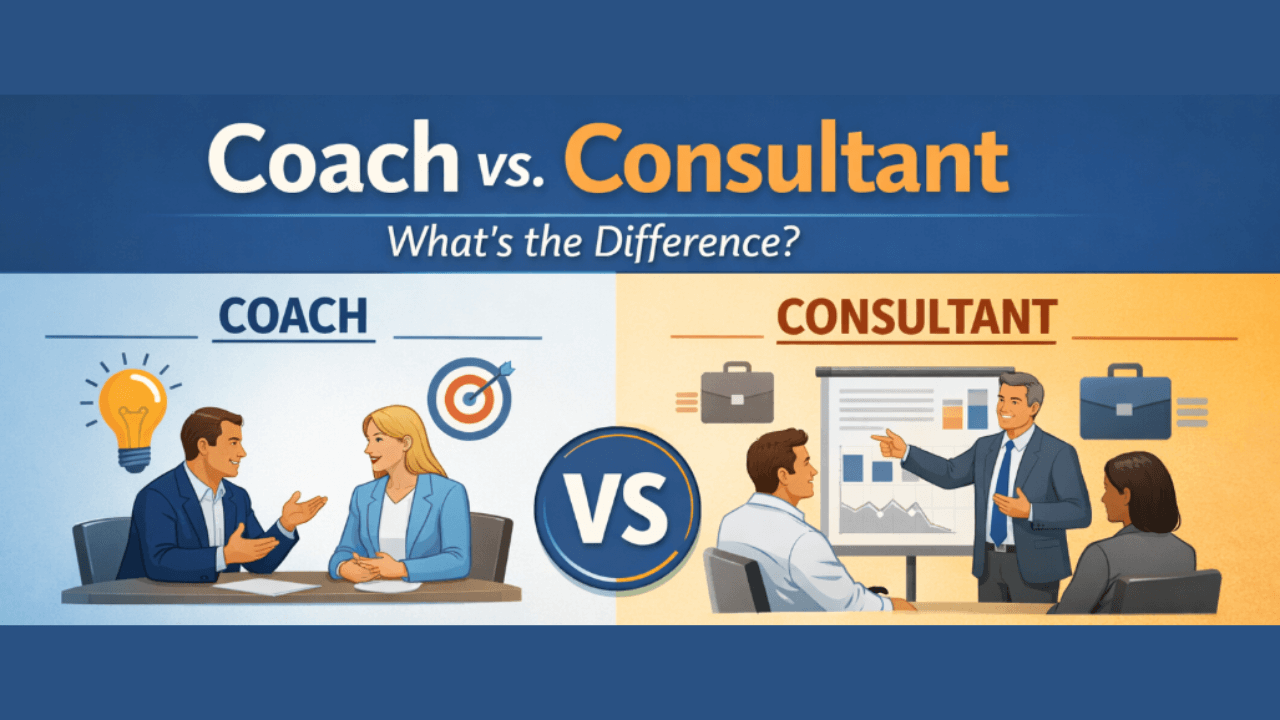
Business owners and executives ask this question because both roles promise improvement. Both work with leaders. Both talk about strategy, growth, and performance. From the outside, business coaching and consulting can look similar.
The direct answer is this: a consultant typically tells you what to do and may help implement it, while a coach helps you think, decide, and execute more effectively yourself. A consultant provides solutions. A coach develops the leader.
Both have value. They simply serve different purposes.
The Core Difference in Approach
A consultant is usually hired for expertise in a specific area such as operations, marketing, finance, or technology. They analyze a problem, recommend solutions, and sometimes implement those solutions. The relationship is often project based.
A business coach or executive coach focuses on improving the leader’s decision-making, clarity, accountability, and performance. The goal is not just solving one problem, but strengthening the leader and the organization over time.
Consultants often transfer knowledge. Coaches build capability.
What Consultants Typically Do
Consultants are most helpful when:
- A company needs specialized technical expertise
- A defined problem requires analysis and redesign
- Internal capacity is limited
- Speed of implementation is critical
For example, if a company needs a new compensation structure or a systems overhaul, a consultant may design it.
The advantage is speed and subject matter depth. The tradeoff is dependency. When the consultant leaves, the organization must sustain the change.
What Coaches Typically Do
Business coaching and executive coaching focus on:
- Strategic clarity
- Leadership development
- Accountability systems
- Decision-making discipline
- Long-term business growth coaching
A coach does not usually build the marketing plan or redesign the accounting system. Instead, they help the leader think through strategy, evaluate options, align the leadership team, and execute consistently.
The advantage is sustainable leadership strength. The tradeoff is that it requires personal effort and behavioral change.
Misconceptions About Coaching Versus Consulting
Misconception 1: Coaches lack expertise and only ask questions.
Strong coaches bring structured frameworks, pattern recognition, and business experience. They simply apply it differently than consultants.
Misconception 2: Consultants guarantee results, while coaching is abstract.
Neither role guarantees outcomes. Both depend on execution. Coaching outcomes are often tied to leadership discipline rather than a single deliverable.
Misconception 3: You must choose one or the other.
Many high-performing organizations use both. Consultants handle specialized execution. Coaches strengthen the leadership that oversees it.
When Coaching Helps and When Consulting Is Better
Coaching is especially valuable when:
- The business has recurring decision bottlenecks
- Growth has stalled due to leadership constraints
- Internal alignment is weak
- Accountability systems are inconsistent
- The owner wants executive support rather than outside control
Consulting may be more appropriate when:
- A technical system must be redesigned
- Legal, tax, or compliance work is required
- A specific operational process must be engineered
- Immediate specialized implementation is needed
The key question is whether the challenge is structural expertise or leadership capacity.
What Most Leaders Do Not Realize
Many business challenges that appear technical are actually leadership issues.
For example:
- Poor execution often stems from unclear expectations
- Strategy confusion may result from inconsistent communication
- Underperformance can reflect weak accountability
In these cases, management coaching or leadership coaching may be more effective than hiring another consultant.
That said, coaching does not replace accountants, attorneys, or technical experts. It complements them.
How Focal Point Approaches This Distinction
At Focal Point Business Coaching Ohio, the focus is on structured business coaching and executive coaching designed to build long term leadership capability.
Coaches use proven systems to:
- Clarify strategy
- Establish measurable goals
- Improve decision velocity
- Strengthen accountability
- Support leadership development
They do not position themselves as technical consultants in every discipline. When a situation requires specialized expertise, clients are encouraged to engage the appropriate professionals.
Focal Point coaches collaborate with one another, share resources, and bring collective experience to client work. If a prospect is not a fit for coaching, they are guided toward an alternative that better suits their needs.
Who Should Consider Focal Point Business Coaching Ohio
Focal Point may be a strong fit for:
- Owners seeking structured business growth coaching
- Executives wanting objective executive support
- Leadership teams needing alignment and accountability
- Organizations committed to long-term leadership development
Who May Be Better Served by a Consultant
Consulting may be more appropriate if:
- The need is purely technical or project based
- The organization wants outside experts to design and implement systems directly
- There is no appetite for leadership development work
- The focus is on short-term execution rather than long-term capability
In many cases, the most effective path is a combination of both roles.
Final Perspective
A consultant can change a system. A coach strengthens the leader who runs it.
Understanding the difference helps you invest in the right support at the right time. The decision should be based not on trend or title, but on what your organization truly needs.
Clarity first. Then execution.