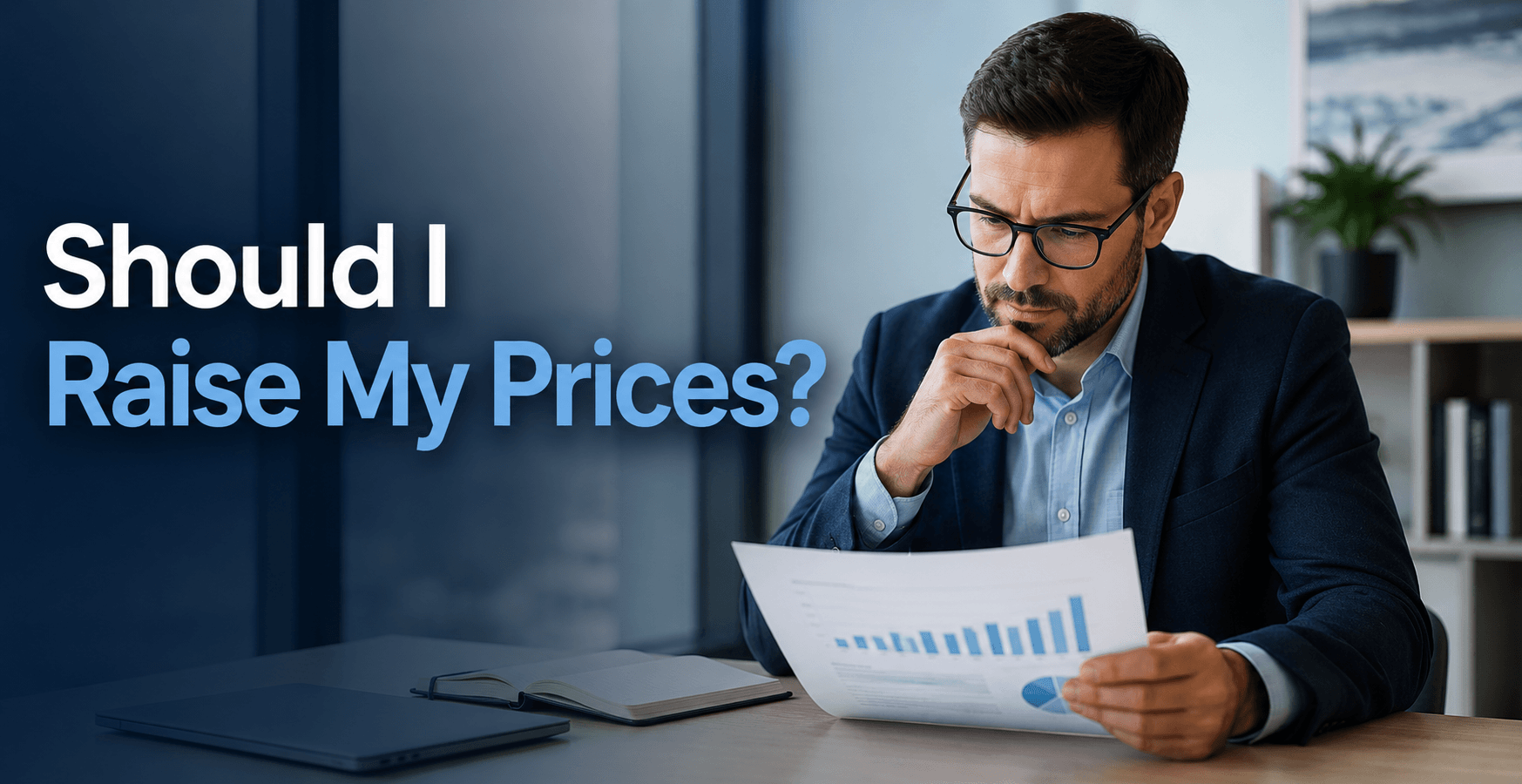
How to know when a price increase protects your business, when it risks customer trust, and how to make the decision with numbers instead of fear
There is a particular kind of anxiety that appears when a business owner realizes the numbers no longer work the way they used to. Sales may be healthy. Customers may be happy. The team may be busy. Yet every month, more of the revenue disappears into payroll, materials, insurance, software, freight, rent, financing, and the dozens of smaller expenses that quietly become more expensive over time.
The obvious answer is to raise prices. The emotional answer is often to wait.
Owners know exactly what could go wrong. A longtime customer might complain. A competitor might stay cheaper. A prospect might walk away. So the business absorbs another cost increase, then another, until being busy and being profitable begin to look like two different things.
The direct answer is this: you should consider raising prices when the economics of delivering your product or service have materially changed, your margins no longer support the business you need to run, or the value you provide has increased beyond what your current pricing reflects. The right increase is not automatically the inflation rate, your competitor’s increase, or an arbitrary percentage. It is the smallest defensible change that restores healthy economics while remaining consistent with the value customers receive.
Why Pricing Deserves Attention Right Now
Pricing pressure is not theoretical. Business owners continue to operate with labor, insurance, technology, materials, and financing costs that are materially different from only a few years ago. Even when headline inflation moderates, the cost base inside an individual business may still require attention.
The important point is not that every business should raise prices. It is that pricing should be reviewed as an active management decision rather than something left on autopilot. Your own costs, margins, customer behavior, capacity, and value proposition matter more than a generic economic headline.
Seven Signs Your Current Price May Be Too Low
1. Revenue Is Growing Faster Than Profit
Growth should create economic leverage. If sales keep rising while profit remains flat or declines, pricing is one of the first variables worth examining alongside labor efficiency, overhead, product mix, and cost to serve.
2. Your Costs Have Changed but Your Prices Have Not
If wages, materials, insurance, software, freight, or financing have risen while your prices have remained fixed, you are effectively choosing to fund the difference from your margin.
3. You Are Consistently at Capacity
A full schedule is not always proof of healthy pricing. If demand regularly exceeds capacity, a price increase may help ration scarce capacity toward customers who value the work most while funding the people and systems needed to grow.
4. Customers Rarely Question Your Price
No price resistance at all can be a signal that you have room to test. It is not proof, but if you have not tested pricing in years and nearly every proposal closes easily, the market may be telling you something.
5. The Business Has Become More Valuable to the Customer
Your service may be faster, more reliable, more specialized, less risky, or more comprehensive than it was when the price was set. Pricing should not be frozen while the value proposition improves.
6. Your Best Customers Are Subsidizing Your Hardest Customers
If some accounts require disproportionate service, customization, rush work, or management attention, a blanket price may hide major differences in cost to serve. Sometimes the answer is a general increase. Sometimes it is account-specific pricing, minimums, service tiers, or fees.
7. You Avoid Investments the Business Clearly Needs
If the company cannot fund competitive wages, technology, equipment, training, or adequate reserves despite healthy demand, the pricing model may be preventing the business from becoming stronger.
How Much Should You Raise Prices?
Start with economics, not courage. Calculate the gross margin and contribution margin you need for the business to operate sustainably. Understand the fully loaded cost of delivering the product or service, including labor, overhead, rework, discounts, customer support, and the cost of capacity. Then model several price scenarios.
A 5% increase does not mean profit rises 5%. In a business with thin margins, a modest price change can have an outsized effect on profit because many costs do not rise with each additional dollar of price. The reverse is also true: if a price increase causes enough volume loss, the benefit can disappear. That is why owners should model both price and expected retention rather than treating price as an isolated number.
Do not simply index every increase to inflation. Inflation is useful context, not a pricing strategy. The stronger question is what your customers believe the outcome is worth, what alternatives exist, and how much pricing power your differentiation actually creates.
Should You Raise Every Customer by the Same Amount?
Not necessarily. Uniform increases are simple to administer and easy to explain, but simplicity can hide meaningful differences. A legacy customer may be dramatically underpriced. A highly standardized account may be extremely profitable. A difficult account may consume twice the support of a similar customer.
Segment customers by profitability, strategic value, price sensitivity, and cost to serve. You may discover that the right move is a broad increase, a larger correction for underpriced legacy accounts, new minimums, a premium service tier, a rush fee, or the removal of discounts that no longer make economic sense.
What Are the Risks of Raising Prices?
The obvious risk is customer loss. That risk is real, and a transparent pricing article should say so. Some buyers are highly price sensitive. Some contracts limit your ability to change rates. Some industries make comparison shopping easy. A large increase delivered without warning can damage trust even when the economics justify it.
There is also a risk in not raising prices. The business may protect revenue while quietly sacrificing margin, service quality, employee capacity, investment, and eventually customer experience. A company that cannot afford to deliver its promise sustainably has not actually protected the customer.
The goal is not zero customer resistance. The goal is a price structure that allows the right customers to receive excellent value while the business earns enough to remain healthy.
How to Communicate a Price Increase Without Hiding From It
Do not bury the change in vague language about market conditions. Customers understand that businesses have costs, but they also want to know what they are paying for. Communicate early when possible. State the new price, the effective date, and what is changing. Explain the business rationale briefly, then return the conversation to value.
Avoid apologizing for operating a sustainable company. At the same time, avoid sounding entitled to a customer’s acceptance. A price increase is a business decision; the customer still has a decision to make. Respecting both sides usually produces a stronger conversation than defensiveness or excessive justification.
A Practical Pricing Review
- Calculate gross margin and contribution margin by product, service, or customer segment.
- Identify costs that have materially changed since the last price review.
- Compare your price with the value and outcomes customers receive, not just competitor rates.
- Review win rates, discounting, capacity, backlog, and customer churn for signs of price sensitivity.
- Model several increases and estimate the volume loss each could withstand before the increase becomes uneconomic.
- Test where possible with new customers, new proposals, or a defined segment before changing the entire book of business.
- Communicate clearly and give customers reasonable notice when contracts and circumstances allow.
- Measure retention, margin, sales conversion, and customer feedback after the change.
When a Price Increase Is Not the Answer
Pricing cannot rescue a weak value proposition indefinitely. If customers are leaving because quality is inconsistent, service is unreliable, competitors have created a genuinely better alternative, or the business has uncontrolled costs, raising prices may simply accelerate the problem.
Sometimes the better answer is to simplify the offer, improve productivity, eliminate unprofitable work, renegotiate suppliers, redesign staffing, or reposition the business. Pricing is powerful because it affects the economics quickly. That is precisely why it should not become a substitute for fixing an operating problem.
The Bottom Line
Raise prices when the current price no longer supports the economics of delivering the value customers expect, or when the value of the offer has materially increased. Do not raise them simply because everyone else is doing it, and do not avoid an increase simply because someone might object.
A healthy price is a compact between the customer and the company. The customer receives an outcome worth paying for. The company earns enough to deliver that outcome consistently, invest in its people and systems, and remain strong enough to serve the customer tomorrow.
The most dangerous price is often not the one a customer questions. It is the one an owner has never questioned at all.