
The Numbers That Tell You Whether Your Business Is Actually Getting Healthier
Walk into almost any business on the first Monday of the month and you’ll find someone studying numbers.
For some owners, it’s yesterday’s sales. Others check the bank balance before they’ve even finished their first cup of coffee. Department managers may be reviewing production reports while accountants reconcile invoices and payroll. Everyone is looking at data, yet surprisingly few organizations are looking at the numbers that best predict long-term success.
That distinction matters.
A company can post record sales while quietly becoming less profitable. Customer satisfaction can remain high while employee turnover steadily increases. Cash in the bank can create a false sense of security even as margins begin to shrink. Looking at a single metric rarely tells the whole story.
The healthiest businesses don’t measure everything. They identify the handful of indicators that reveal whether the organization is becoming stronger, more resilient, and better positioned for future growth.
The challenge isn’t collecting more data. Modern software can generate dashboards with hundreds of metrics. The real challenge is knowing which numbers deserve your attention and understanding what those numbers are trying to tell you.
Why Business Metrics Matter
Every decision a business owner makes is based on information, whether that information comes from experience, instinct, or measurable data. Experience and intuition have tremendous value, particularly for seasoned leaders, but relying on instinct alone becomes increasingly difficult as a business grows.
As organizations become more complex, owners often spend less time directly involved in every customer interaction, employee conversation, or operational decision. Metrics become the language that helps leaders understand what is happening throughout the organization without needing to oversee every detail personally.
That doesn’t mean every decision should be driven by spreadsheets. Numbers provide context, not certainty. They help leaders ask better questions, identify trends earlier, and make more informed decisions.
The most effective leaders combine measurable data with sound judgment.
Revenue Is Only the Beginning
Revenue is usually the first number owners mention when asked how the business is performing, and for good reason. Without consistent revenue, very little else matters.
The problem is that revenue alone can create an incomplete picture.
Imagine two companies that each generated $10 million in annual sales. At first glance, they appear equally successful. Dig a little deeper, however, and the story changes. One company is generating healthy profits, retaining customers, maintaining strong cash flow, and developing future leaders. The other is winning new business while discounting heavily, struggling to collect receivables, and losing experienced employees.
The revenue is identical. The health of the businesses is not.
That’s why experienced leaders rarely evaluate performance using a single number.
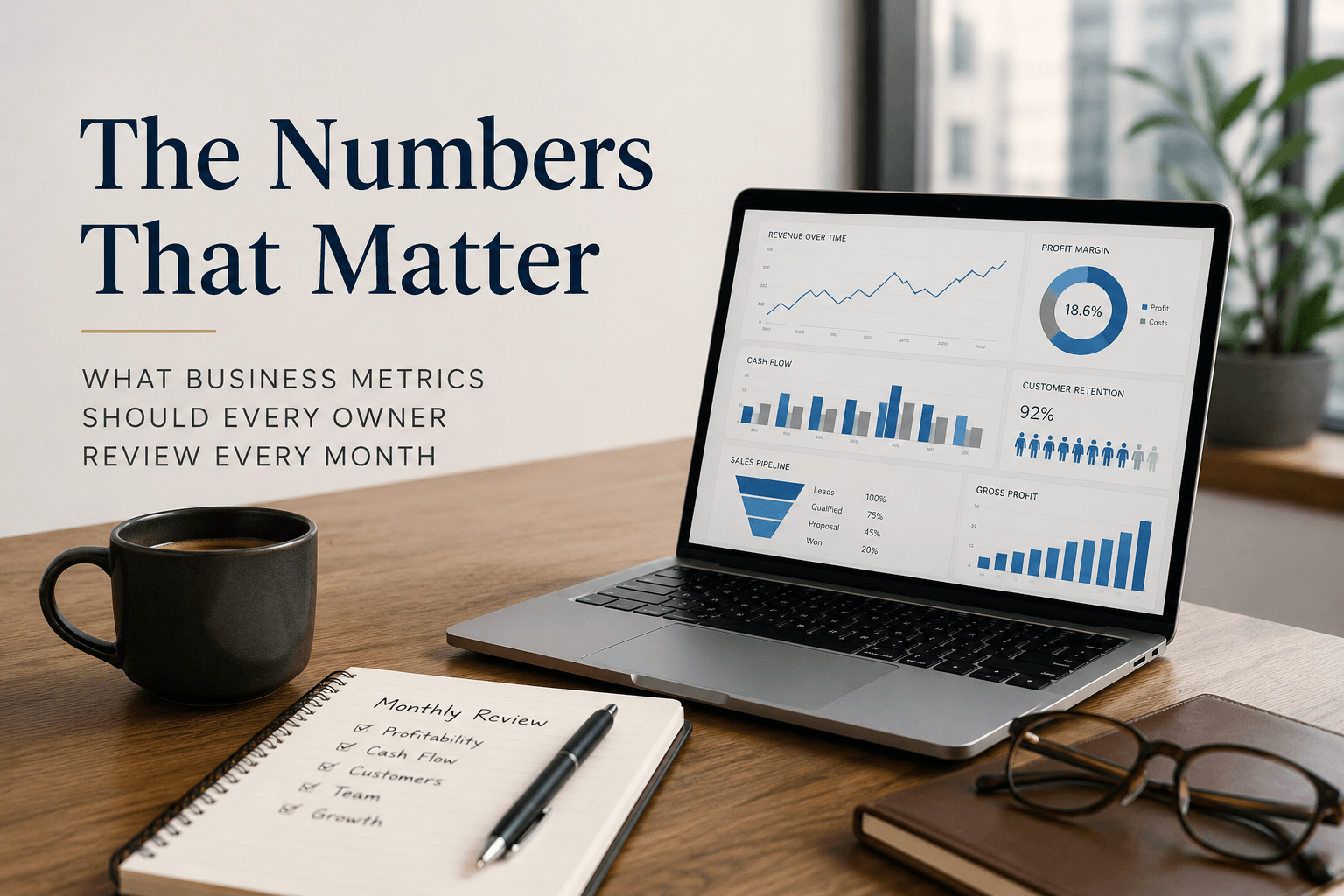
The Metrics Every Business Owner Should Review
While every organization has industry-specific measures, there are several core metrics that provide valuable insight regardless of size or industry.
Profit Margin reveals whether growth is creating financial strength or simply increasing workload. Healthy revenue without healthy margins often signals pricing issues, rising costs, or operational inefficiencies.
Cash Flow remains one of the clearest indicators of business health. Companies rarely fail because they are profitable on paper. They struggle when cash is unavailable to meet payroll, purchase inventory, or invest in future growth.
Customer Retention often tells a more meaningful story than new customer acquisition. Retaining loyal customers is typically less expensive than constantly replacing them, and long-term relationships often lead to stronger profitability.
Employee Turnover provides insight into leadership, culture, and engagement. High turnover increases recruiting costs, disrupts productivity, and often signals deeper organizational issues.
Gross Profit helps owners understand whether the products or services they sell are generating sufficient value before overhead expenses are considered.
Accounts Receivable Aging shows how efficiently the business converts sales into cash. Strong sales lose value if invoices remain unpaid for months.
Sales Pipeline Health looks beyond today’s revenue to evaluate future opportunities. A strong month means little if next month’s pipeline is empty.
Productivity Metrics vary by business but help determine whether teams are improving efficiency or simply working harder.
Customer Satisfaction offers an early warning system. Businesses that consistently listen to customers often identify problems before they become expensive.
Finally, Goal Progress deserves a place on every monthly review. Strategic plans have little value if leadership teams never measure whether priorities are actually being accomplished.
What Most Owners Don’t Realize
One of the most common mistakes is measuring only outcomes instead of the activities that produce those outcomes.
Revenue, profit, and cash flow are important, but they are lagging indicators. They tell you what has already happened.
Leading indicators, such as proposal activity, customer meetings, employee engagement, production efficiency, or sales pipeline growth, provide earlier insight into where the business is heading.
Successful leaders review both.
They celebrate results while paying close attention to the behaviors that create those results.
When Metrics Become Counterproductive
Not every number deserves equal attention.
Many businesses unintentionally overwhelm themselves by tracking dozens of key performance indicators. Meetings become exercises in reviewing dashboards rather than making decisions.
A smaller group of meaningful metrics usually creates better conversations.
The goal is not to collect information. The goal is to improve decision-making.
If a metric never influences a decision, it may not deserve a place on the monthly scorecard.
How Business Coaching Can Help
Knowing which metrics to review is only part of the equation. The more challenging question is often what those numbers mean and how leaders should respond.
That is one area where business coaching can provide value.
Rather than simply reviewing financial reports, an experienced coach helps leadership teams connect performance metrics to strategic goals, accountability, and decision-making. The conversation shifts from “What happened?” to “Why did it happen, and what should we do next?”
Focal Point Business Coaching Ohio approaches these conversations through structured business systems rather than assumptions. The objective is not to create more reports or more meetings. It is to help leaders focus on the information that supports better decisions and sustainable growth.
Coaching cannot eliminate uncertainty, nor can it guarantee business success. Markets change, competitors evolve, and unexpected challenges arise. What coaching can do is help leaders develop stronger habits for evaluating performance, asking better questions, and making thoughtful decisions based on evidence rather than emotion.
The Bottom Line
Every business generates data. The organizations that consistently outperform their competitors are not necessarily the ones with the most information. They are the ones that know which information matters.
Reviewing the right business metrics every month provides leaders with more than numbers. It provides perspective. It highlights opportunities before they become obvious, exposes problems before they become crises, and helps leadership teams align decisions with long-term objectives.
The question is not whether your business is measuring enough.
It is whether you are measuring what matters most.